Why Is It Important to Write About What You Read

(This is the first post in a two-part series)
The new question-of-the-week is:
In what ways tin writing support reading instruction?
All of us plain want to assistance our students get better writers. But are there ways we tin can "double-dip," as well—in other words, assistance them better their writing AND also use writing pedagogy to meliorate reading skills?
We'll explore that question today with Tony Zani, Mary Tedrow, Mary Beth Nicklaus, Colleen Cruz, and Pam Allyn. Yous tin can listen to a 10-minute conversation I had with Tony, Mary, and Mary Beth on my BAM! Radio Show. You lot tin also find a listing of, and links to, previous shows here.
Giving kids the 'write stuff' makes them better readers
Tony Zani is a literacy jitney in the Table salt Lake City schoolhouse district. He has a bachelor's degree in simple instruction and a master's caste in instructional leadership. Tony is a national-board-certified teacher with a specialization in early-childhood instruction:
Writing is often the disregarded content area. After the National Reading Panel left information technology out and No Child Left Behind focused on reading accomplishment, there seemed to exist a refuse in teaching writing. Later the Common Core State Standards came out, there was an increase in writing instruction. But, if your state is like mine, writing is simply tested in a few grades. Then, guess what? Those are the grades when writing is taught like crazy. In other grades, it often becomes a nice matter "if there's time." At that place'due south rarely time.
This mentality is prevalent considering every level of the education arrangement focuses on making sure students do well on end-of-twelvemonth, high-stakes assessments. Jobs are at stake. Coin from the government is at stake. Heaven forbid your schoolhouse does so poorly that an outside group comes in to help you "turnaround."
Never fright, though. Writing directly benefits students' reading skills. For instance, if y'all accept students write about what they've read or learned (for nearly any content or age), you'll dramatically meliorate reading comprehension. Students are often forced to reread and think more deeply about what they've read. When students have to consider a controversial question and use texts they've read to defend their point of view, reading comprehension is off the charts. In our school, we've emphasized writing about what we read. It took most two years for near teachers, and students, to really embrace the concept. Information technology was about that time that our end-of-yr reading scores had a huge jump. Our highly impacted Title I schoolhouse made enormous growth just because students were better at thinking about what they read.
Writing also improves students' reading fluency. When students take to stop and think about what spelling patterns to use when they write, they are making a deeper connectedness in their brains about sound and spelling patterns. This deeper connectedness makes it easier, and faster, for students to think those same patterns when they read. Written language is literally a underground code that someone made upward to represent spoken sounds. The more students think about and practice the code in written form, the meliorate they will be at understanding the same code in writing. Again, in our high-needs school, we saw students' scores on tests like DIBELS and our end-of-level examination ascent dramatically. Fluent readers more securely sympathise that lawmaking.
Writing as well improves reading comprehension as students go ameliorate at formatting their writing. When students write argumentative essays, they learn how authors oftentimes lay out their arguments and evidence. This, in plow, gives students a framework for reading others' argumentative writing. Having a framework in your mind helps you lot make full in the blanks and improves comprehension. When students write narrative pieces, they develop an agreement of how authors typically lay out grapheme development, setting, plot, problems, turning points, and resolutions. Over again, students have a framework to build upon when they read others' narrative texts. In a bit of irony, our school focused on writing informative and argumentative pieces—those are emphasized in the common core, right? Our students had very high scores when reading advisory texts. However, students scored lower when reading literature. Reading literature was a strength for near other schools. Writing in all genres is important. Don't lose that remainder!
Writing is a disquisitional communication skill. Universities and employers oft complain that writing is an underdeveloped skill. It'southward no wonder, when nosotros have an education system that oft relegates writing to the country of "I wish nosotros had time" and "That'due south not on the test." What a tragedy. Teaching students to be effective writers is of import by itself. However, writing also provides big gains in reading comprehension and reading fluency.
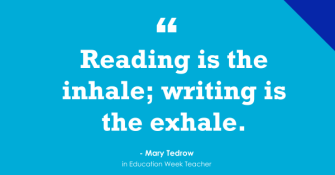
'Reading is the inhale; writing is the exhale'
Mary K. Tedrow, an award-winning high school English instructor, now serves every bit the director of the Shenandoah Valley Writing Project. Her volume, Write, Think, Learn: Borer the Ability of Daily Student Writing Across the Content Surface area is bachelor through Routledge:
Writing and reading are intricately intertwined. One is the inverse of the other: Reading is the inhale; writing is the exhale. They depend on each other, and when we find time to practise both, the students are the winners.
In the primeval readers, writing is a natural way to ingest and experiment with a growing knowledge of letters and their function in symbolizing the sounds we speak. Encouraging students to write, even earlier they know all the rules, builds a deeper agreement of how reading works. In kindergarten, the inventive spelling students use to compose early writings allows children to represent on the page what they are hearing in the earth. Children more clearly understand the letter/audio human relationship as they compose thoughts and stories in writing. Contempo research has revealed that students who are given latitude to utilise inventive spelling become ameliorate readers (Oulette & Senechall, 2017).
But the interplay between writing and reading goes well beyond but learning to read. When students are asked to write for their own purposes, they intuitively understand the choices authors make equally they create a piece of work that moves a reader.
Teachers who have students writing authentically—that is, the way real writers write—can interrupt the process and teach craft lessons. Evidence students how to develop several skillful beginnings and inquire them to cull the i which serves their purpose best. Show how to comprise the senses in description, how to move a plot forward through dialogue, how to manipulate sentences for dial and clarity.
All of these writing skills are the inside/out version of analyzing writing by others. When we analyze the books, poetry, and essays we read, we are simply describing the choices an writer made on their road to composing a piece. When students are heavily involved in creating those pieces themselves, they will more easily see what authors are doing and understand the messiness required in producing effective advice. Writing brings the author and his or her skill to life.
Students who write are better, more observant, and appreciative readers in full general. And students who read are better, more competent writers. Be certain your students take the risk to exhale in and out throughout the day.
Ouellette, G., & Sénéchal, M. (2017). Invented spelling in kindergarten as a predictor of reading and spelling in Form 1: A new pathway to literacy, or only the same road, less known? Developmental Psychology, 53(one), 77-88. http://dx.doi.org/10.1037/dev0000179
'Lure' students into reading through working with their writing
Mary Beth Nicklaus is a secondary-level teacher and literacy specialist for the Wisconsin Rapids public schools in Wisconsin:
I take found it possible to lure secondary-level students into the reading globe through working with their writing. I work with 6-ninth course struggling readers as a reading specialist and literacy coach. By the time they are referred to me, they have not been reading for years—which accounts for much of their struggle. When we teachers work through the power of written self-expression with and for these students, nosotros can also tinker with content-specific bookish vocabulary, text construction, and mechanics of writing. We can also prime number and build basic reading and comprehension skills. Even researchers take constitute that use of reading-response writing, explicitly teaching writing process, and engaging students in wide writing practice enhances basic reading skills and comprehension in Yard-12 readers. Here are some strategies I accept establish to be successful working with secondary-level students based on the aforementioned iii areas:
- Create reading-response writing opportunities focusing on opinions and feelings of the reader. By the time they are in 6th grade, most students want to share data nigh interests and opinions. How can nosotros connect that interest into reader response? To brainstorm with, we don't always accept to work with published text. We tin can create our own texts in the classroom. We teachers can start the process by writing a letter to students sharing some full general data and interests. The instructor then guides the students to write a letter back to them with like information. This experience encourages students to begin sharing and expressing themselves in writing. Get into the addiction of crafting student-writing response assignments for which nosotros are asking most students' feelings and opinions regarding classroom reading—even soliciting poetry writing if that genre works best for some students. Students may as well find starting with a salutation hailing a specific audience helps them focus their thoughts in their writing. "Dear teacher/course/partner, I think that____." They can also focus on sharing their writing with a partner or small grouping.
- Teach the writing process relative to classroom text. Teach students a few writing structures to clearly communicate thoughts and ideas. Teach the main structures of the text you apply in your content—exist it narrative or expository structures. Let's say we desire to teach students to compare and contrast within a classroom text on the running of restaurants. We might use a Venn Diagram graphic organizer to compare and contrast the information about restaurant operation with them on the smartboard. Allow the course to aid fill up in data. Then together, flesh out a comparing-contrast response with a question like, "Based on our reading today, what might be a more hard eating place to run, Culver's or Buffalo Wild Wings?" Use a template to assemble student input to flesh out a response. Teach students to support viewpoints with show from the text and bear witness them a specific way yous will always want them to apply to cite bear witness. Allow the class to help design or co-create a rubric for evaluating writing, which will assistance students internalize the elements of the specific writing. Steer the strategy to a similar text where you might use the same kind of structure and response.
- Engage in wide practice of written response: Standing both "big" and "little" writing in our classes, based on the structures and types of texts nosotros teach, can increase reading comprehension. Working on mechanics of writing improves basic reading skills like fluency and word recognition. In addition, continue to practice reading, writing, and reflecting and sharing in whole-group, pocket-size-grouping, and partner contexts. Have students create "Why?" questions to inquire about text. Supply sentence stems to help students focus their text response with their writing such as, "I call back ___________ did what he did because in the story_______." Make information technology a habit of requiring written response in the class of exit response slips where students within a limit of 3-5 minutes, quickly write a response to an enquiry regarding what they learned through the reading. Wide exercise of writing helps students' classroom reading become 2nd nature, and information technology helps prune their focus on text.
I know the strategies I have elaborated upon piece of work, because my students made enormous, lasting gains in their reading through focusing on writing. Also, the gains secondary-level students tin make through focusing on feelings and opinions in their reading-response writing foster livelier conversations during classroom give-and-take. Students' overall gains even testify students that content texts across the curriculum can pique their interests outside of the classroom. It's a win-win all around!

Having students annotate their writing with the Strategies they use
Colleen Cruz is the author of several titles for teachers, including The Unstoppable Writing Teacher, as well as the author of the young-adult novel, Border Crossing, a Tomás Rivera Mexican American Children'southward Volume Award Finalist. She was a classroom teacher in general education and inclusive settings earlier joining the Teachers College Reading and Writing Projection, where every bit the director of innovation, she shares her passion for accessibility, 21st-century learning, and social justice. Most recently, Colleen authored Writers Read Better: Nonfiction (July 2018) and Writers Read Improve: Narrative published by Corwin:
As an educator who works with teachers and students in grades 2 through 8, I find that I often look at the practices of primary-course teachers and wish we upper-grade folks borrowed more heavily from them. Whether it exist a focus on individual development, an emphasis on play, or just an overarching focus on the whole child, in that location are pedagogical treasures we need to bring more to our big-child classrooms. At present, the most pressing for me is the desire to use writing to support reading teaching more ofttimes.
Every kindergarten and 1st grade teacher I know asks students to write as soon as they enter the classroom. This is long before students know the unabridged alphabet or how to read whatever words. In fact, nigh of united states of america who have had little ones at home can attest to how often kids choice up a marking or crayon and write their names, strings of letters, or familiar words. Our youngest learners often produce words before they consume them. And when they do that, they are setting themselves up for success as readers considering they learn early on on, if they can write their proper name they can read it. If they can write any word, they tin read information technology.
Too, many of us grew up every bit educators with the cognition that reading supports writing. I first learned how this conventional wisdom applies to children's writing from Katie Ray and her seminal book Wondrous Words. Then, information technology should non be all that revolutionary to notice that those early-writing and -reading connections however utilise when students move into more circuitous reading.
Yeah, they might have moved by simple decoding and literal comprehension work. But the office of writing and reading reciprocity still applies. For every comprehension move a reader makes, there is an author on the other side of the desk. If a immature reader is also a writer, they volition be well-positioned to see the mirror moves they have made equally a author in the texts they are reading by other authors. Studies take shown this, of course (Graves, Calkins, Chew, Graham & Hebert to name a few). Merely in my work with young readers and writers I accept seen fourth dimension and again that if something is challenging to a reader, 1 of the about accessible paths to overcoming that challenge is through writing. It's a transferable agreement that can concluding a lifetime: Show students that every reading skill has a reciprocal writing skill, and if they have written something like it, they are able to read it well, besides.
One of my favorite means to do this is to ask students to annotate their writing with the strategies they tried as writers and the reasons why. For case, "I used show-don't-tell in this paragraph to help make a moving-picture show in my reader'southward mind." I and then ask them to read a book of their choice with their own writing nearby. When they come to a spot in the text they find challenging, they can look back to their own writing to see if they made a like move and why. A few mutual writing/reading reciprocal moves I teach students include:
- Prove-not-tell in writing helps readers to infer in reading.
- Plotting in writing helps readers to make predictions in reading.
- Developing objects equally symbols in writing helps readers translate symbols in reading.
- Defining a word in writing helps readers to sympathise the meaning of an unknown word.
In that location are, of class, countless more than.
We know the power of modeling. And I believe for many years, rightly so, we take taught students how to mine the power of the published word for ideas for their ain writing. For many of us, information technology'southward time to try to teach the power of modeling past asking students to await at their ain writing equally their mentor for their reading lives. I am hard-pressed to think of more than empowering reading work.
Writing 'is a powerful lever for helping our students learn to read greatly'
Pam Allyn, senior vice president, innovation & development, Scholastic Education, is a leading literacy expert, author, and motivational speaker. In 2007, she founded LitWorld, a global literacy arrangement serving children across the United States and in more than threescore countries, pioneering initiatives including the summertime reading program LitCamp and World Read Aloud Twenty-four hours:
Writing and reading are not but ii sides of the same money; they are profoundly related and entwined. I accept often said that reading is like breathing in, and writing is like animate out—the child is taking new breaths in this new world, feeling her power and her potential.
Surrounding our children in the sounds of language from literary and informational text is crucial to their understanding of language. The child who is read aloud to multiple times per day, calendar week, month, and twelvemonth is already realizing the sound and feel of linguistic communication. And so, likewise, the child who is given the opportunity to put her first marks on the page is already beginning to make meaning in the world. When reading a book, she sees information technology as something synthetic from a world she already knows because her scribbles connect to those of others and give her the powerful idea that she has a vocalism.
Writing early and constantly, in and out of school, is a powerful lever for helping our students learn to read profoundly. Hither are five ways writing supports reading and vice versa:
1. Edifice a deep sense of the dazzler of grammar, audio, and vocabulary
The educatee who writes becomes alert to the structure of sentences, the rhythm of multiple words together, and words that surprise. Because our students are using the tools of language to build their own stories, they are awake to the qualities of texts. When students share works by authors such as Jacqueline Woodson or Naomi Nye, they're astounded and try to emulate them in their own writing.
2. Understanding the purpose of and utilise of genres
Students who write quickly learn the necessity of genre. My 1st graders were writing informational texts and choosing their own topics. One wrote virtually nursing homes because that'due south where her grandpa was. Later, I saw her scouring a book with a glossary in information technology. She explained, "I want to add a glossary to my story. My readers might need to know some of the big words I apply to describe where my grandpa lives." Genre is already embedded within her at the age of 6.
3. Recognizing the power of writing to connect us
Students who write understand that by telling their stories, they're making their thoughts permanent, which leads to a hearty respect for the text, the authors who write them, and the uses we make of them. When our student writers are finishing works to put into the classroom library, they have an opportunity to meet themselves next with published works, which feels celebratory. Writing, theirs and others, inspires and connects them.
four. Becoming enlightened of the ways writing can change someone'south heed or change the world
Even the smallest writer has big ideas. My 2nd grade class once wrote letters to the entire neighborhood inviting them to come see our play. People young and quondam came, and students saw how they could change their communities with the power of their ain words. So, when they read, they consider all the ways writers tin change people.
five. Knowing and deepening one'south ain writing and the voice of an author
The student who writes is edifice confidence, courage, and a sense of self. She is learning how to evoke emotion, keep someone in suspense, and persuade while developing her ain vocalism, which will serve her in the future whether she's writing a narrative or an email. When she turns to her reading, she is now more than aware of the author's voice and knows the risks the author takes. She is i herself.
Thanks to Tony, Mary, Mary Beth, Colleen, and Pam for their contributions.
Please feel free to exit a comment with your reactions to the topic or directly to anything that has been said in this post.
Consider contributing a question to exist answered in a hereafter post. You can send i to me at lferlazzo@epe.org. When you transport it in, let me know if I can employ your real name if it's selected or if you'd prefer remaining anonymous and accept a pseudonym in mind.
You can besides contact me on Twitter at @Larryferlazzo.
Education Week has published a collection of posts from this blog, forth with new textile, in an e-book form. Information technology'due south titled Classroom Management Q&As: Proficient Strategies for Teaching.
If you missed whatever of the highlights from the first eight years of this blog, you can see a categorized list beneath.
- This Year'southward Virtually Popular Q&A Posts
- Race & Gender Challenges
- Classroom-Management Advice
- Best Means to Begin the School Year
- Best Means to End the School Year
- Implementing the Common Core
- Student Motivation & Social-Emotional Learning
- Didactics Social Studies
- Cooperative & Collaborative Learning
- Using Tech in the Classroom
- Parent Engagement in Schools
- Teaching English-Language Learners
- Reading Instruction
- Writing Instruction
- Education Policy Issues
- Assessment
- Differentiating Instruction
- Math Instruction
- Science Didactics
- Advice for New Teachers
- Author Interviews
- Inbound the Didactics Profession
- The Inclusive Classroom
- Learning & the Brain
- Ambassador Leadership
- Teacher Leadership
- Relationships in Schools
- Professional person Development
- Instructional Strategies
- All-time of Classroom Q&A
- Professional person Collaboration
- Classroom Organization
- Mistakes in Education
- Projection-Based Learning
I am likewise creating a Twitter list including all contributors to this cavalcade.
Expect for Office 2 in a few days.
The opinions expressed in Classroom Q&A With Larry Ferlazzo are strictly those of the author(southward) and exercise non reflect the opinions or endorsement of Editorial Projects in Education, or any of its publications.
pickeringfratirld.blogspot.com
Source: https://www.edweek.org/teaching-learning/opinion-writing-directly-benefits-students-reading-skills/2020/01
0 Response to "Why Is It Important to Write About What You Read"
Publicar un comentario